
Can I legally publish an AI-generated anime illustration if I wrote the prompt, chose the model, and edited the final image myself?
This is a reasonable question, especially if the illustration is headed for a client, a game, merchandise, a webcomic, or another commercial project.
The first thing to understand is that using an AI image generator and owning copyright in the resulting image are separate questions. A platform may let you use its output, but the copyright status of that output may remain limited or uncertain.
For instance, your own original character and artwork may contain human-created elements that can receive copyright protection, while the final artwork might depict a copyrighted anime character and raise separate questions.
Also, keep in mind also that AI art copyright rules vary by country, and courts are still working through how existing law applies to generative AI.
For anime creators, the useful approach is to look at the actual workflow as well as the terms governing AI anime platforms such as PixAI. What did you create? What did the AI generate? What did you change? And what else went into the image?
Does AI-generated anime art automatically have copyright protection?
Generating an image does not automatically mean you receive copyright over everything in it.
Copyright generally protects original human expression. In the United States, the Copyright Office currently says material generated entirely by AI cannot receive copyright protection, while AI-assisted works can be protected where a human contributes sufficient expressive material.
And no, providing prompts alone does not establish the required human authorship.
Say you type a prompt into PixAI’s image generator describing a silver-haired anime character standing beside a river. The generator creates the entire image, after which you pick the best result and download it.
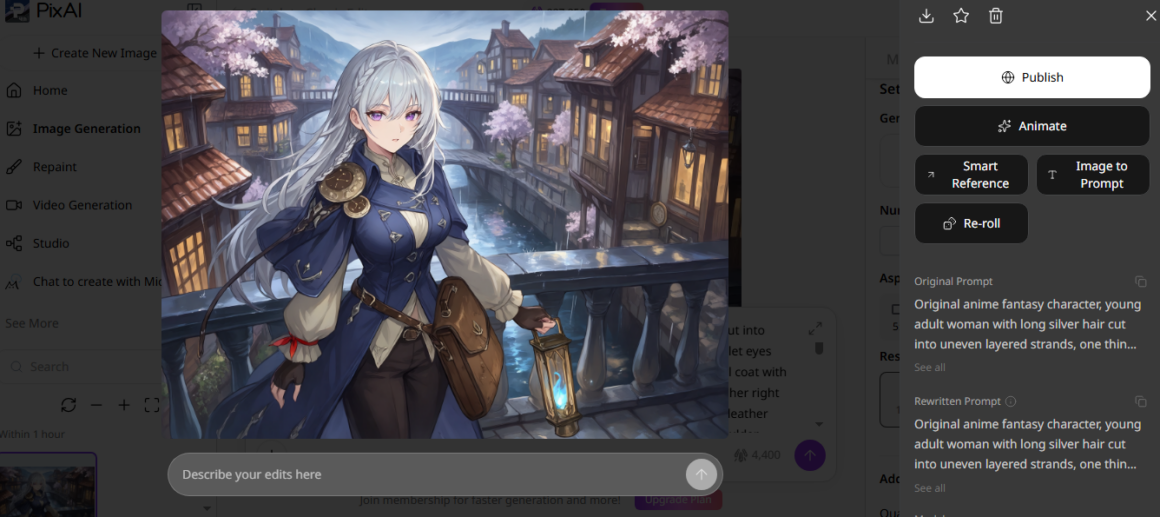
You made creative decisions. But deciding what to ask for doesn’t necessarily mean you own copyright in every visual decision the system makes.
Now let’s say you designed the character yourself, supplied your own sketch as a reference, chose the composition, replaced several elements, redrew the face, added your own background, and manually retouched the final image. The finished work has much more human creative input.
But once again, this doesn’t create an automatic formula. The legal landscape surrounding AI art and copyright is still evolving, and the existing patchwork of rules differs significantly by jurisdiction. Currently, there’s no uniform global standard.
If you plan on using your image commercially, keep a record of how you made it.
What counts as human creativity in an AI artwork?
Anime workflows can involve human creativity long before you write the final prompt.
You may have designed the character, planned the scene, chosen the pose, created reference material, selected a model or LoRA, generated multiple versions, picked specific outputs, edited individual elements, and composited the final image.
All of that can matter when considering what human input exists in the finished work. The final image may be AI-generated, but it also contains human creative decisions and modifications. Under the U.S. Copyright Office’s current analysis, for instance, those kinds of human contributions can matter for copyrightability.
For creators using PixAI, a workflow might look like:
Character design → reference → generation → selection → editing → compositing → final artwork
Keeping a record of those stages gives you a clearer picture of where your own creative contribution enters the final image.
Check the AI tool’s terms before publishing commercially
This is another question to check separately. Does the AI platform allow you to use the output the way you intend?
That is a platform and licensing question, and it’s different from copyrightability.
Before using an image commercially, look at the current terms for the platform you used. Check the rules around generated content, commercial use, licensing, user uploads, private generations, and any special conditions attached to models or features.
For example, PixAI provides a straightforward example. Its current terms allow you to freely use the content you create for personal and commercial use. The platform also doesn’t claim ownership or copyright of the AI artwork you generate. But keep in mind that paying for a PixAI membership doesn’t make every image you generate safe to sell.
So check the current terms before relying on a platform for a commercial workflow. Policies can change, and old terms can quickly become outdated.
Your original character can be yours, but the AI image is a separate question
Suppose you have spent months developing an original anime character. You created the character sheet, drew early sketches, wrote the character description, and produced several illustrations before using AI to explore new poses and scenes.
Those original materials show your creative contribution, but the AI-generated images need to be considered separately.
Your original character design may contain copyrightable human-created expression. A later AI-generated image of that character may mix your contribution with models or LoRAs created by other users.
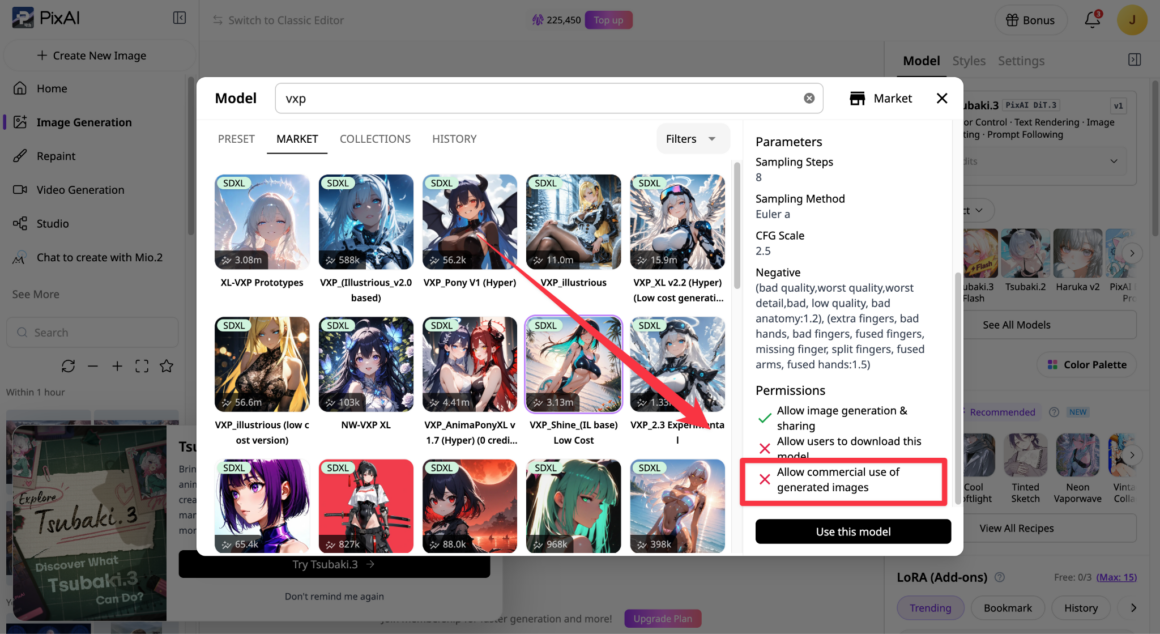
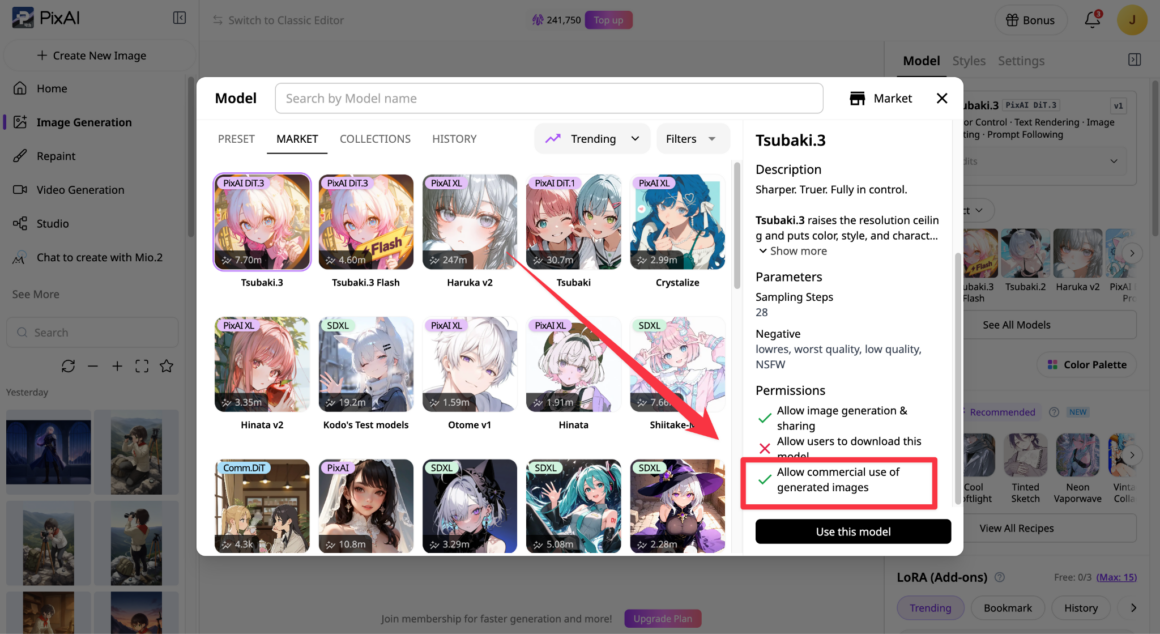
For instance, VXP_Shine, a popular user-created model on PixAI, doesn’t allow commercial use of generated images.
However, PixAI’s flagship models like Tsubaki.3 do.
Be careful with copyrighted anime characters and fan art
The situation is even more delicate when the character belongs to someone else.
Generating a new image of an established anime character does not transfer ownership of that character to you. The AI system may create a completely new image, but the character being depicted can still belong to the original rights holder.
That matters when fan art becomes commercial.
Posting an AI-generated fan-art image is one situation. Selling prints of it is another. Putting the character on merchandise, using it in advertising, or licensing the artwork can raise additional concerns.
Changing the art style does not remove the underlying character. Trademark considerations may also apply when names, logos, or recognizable branding are involved.
The safest way to think about it is to separate the image from the character. You may have created the new illustration, but that does not automatically give you the rights associated with the character inside it.
The exact rules depend on the jurisdiction and the circumstances. While fan art can also involve exceptions or defenses in some situations, commercial use generally deserves closer attention than a personal experiment.
What about AI models trained on copyrighted artwork?
Then there is the question behind the model itself. What was the AI model trained on?
Artists have legitimate reasons to ask whether models were trained using copyrighted illustrations without permission. At the same time, the legality of training an AI model and the copyright status of a particular image generated by that model are different questions.
The U.S. Copyright Office has been examining both issues separately. Its Part 2 report addresses the copyrightability of AI-generated outputs, while its Part 3 work addresses generative-AI training and questions involving copyrighted works, licensing, and potential market effects.
The training debate is still developing. Legal disputes and policy decisions can affect how AI companies collect training data, license material, and operate their models.
That does not mean a creator should assume every model output is automatically infringing because copyrighted material may have appeared somewhere in its training data.
The two questions need to remain separate. For creators, the practical response is to pay attention to the platforms and models they use and keep up with changes that could affect commercial workflows.
What should anime creators do before publishing AI artwork?
Before you publish an important image, run through a few questions.
- Who created the character? If you designed it yourself, keep the original material.
- Did you use a copyrighted character or third-party asset? If so, consider the rights attached to it.
- Which AI tool and model did you use? Record the platform, model, LoRA, and important features.
- Does the current license allow your intended use? Check the actual terms instead of relying on assumptions.
- How much human creativity went into the final image? Look at the character design, composition, selection, editing, arrangement, and manual changes.
- Did you substantially modify the output? Keep the working files where possible.
- Do you have your source material? Save sketches, references, prompts, iterations, and editing files.
- What are you doing with the image? A personal post, print, game asset, client commission, and commercial license can raise different issues.
- Which country’s law applies? Copyright treatment of AI-generated material is not identical everywhere.
The more valuable the project, the more useful that documentation becomes.
How to build a safer AI anime art workflow
The easiest way to handle all of this is to build the checks into the creative process.
- Create. Start with your own character concepts, designs, and references where possible.
- Document. Save the prompts, source material, important generations, and major edits.
- Refine. Make deliberate creative changes through editing, compositing, drawing, or painting.
- Verify. Check the current AI platform terms and review any third-party material involved.
- Publish. Use the finished artwork according to the permissions and rights you have established.
PixAI fits naturally into this type of workflow. You can use it to generate variations, work from references, refine characters, and develop an image across multiple iterations. The key is tracking the creative decisions behind those generations.
That gives you a clearer record of how the finished artwork came together.
Final Thoughts
So, can you legally publish an AI-generated anime illustration that you prompted and edited yourself?
Sometimes the answer will be straightforward. In other cases, you need to look more closely at the human contribution, the platform’s terms, the material used in the workflow, the character depicted, and the law that applies where you are using the work.
Remember, using an AI generator doesn’t automatically settle copyright ownership, and third-party characters raise separate rights questions.
If you’re building an AI anime workflow, PixAI gives you a place to generate, refine, and develop characters across multiple iterations while keeping the creative process organized.
More Stories
The technology behind faster, more data-rich sports betting markets
Make Your Subscription Count! What to Look at Before You Hit Subscribe on an OnlyFans Page
How Online Sportsbook Apps Are Becoming Part of the U.S. Sports Viewing Experience